
How the AI works
This is an overview of how we turn market data into ranked stock signals — and how to interpret them. We focus on clarity and correct usage rather than technical implementation details.

Think of the AI as a professor: excellent at analyzing data and ranking ideas objectively, but designed to inform decisions — not execute trades.
What Stock Outperformers does
Stock Outperformers is a signal engine. It does not place trades for you. It helps you prioritize which stocks to research and potentially act on by ranking candidates using a simple 0–100 score.
We ingest structured market datasets from multiple sources, clean and standardize the inputs, and run several model families designed for different market behaviors.
From data to signals
- Ingest: Fresh datasets from multiple providers.
- Clean: Normalize, deduplicate, and validate.
- Model: Multiple AI approaches score candidates.
- Rank: Scores become a comparable 0–100 list.
- Publish: Results appear in this application.
Application architecture overview
The diagram below shows how data flows through the system — from external providers to models, scoring, and finally into this application.
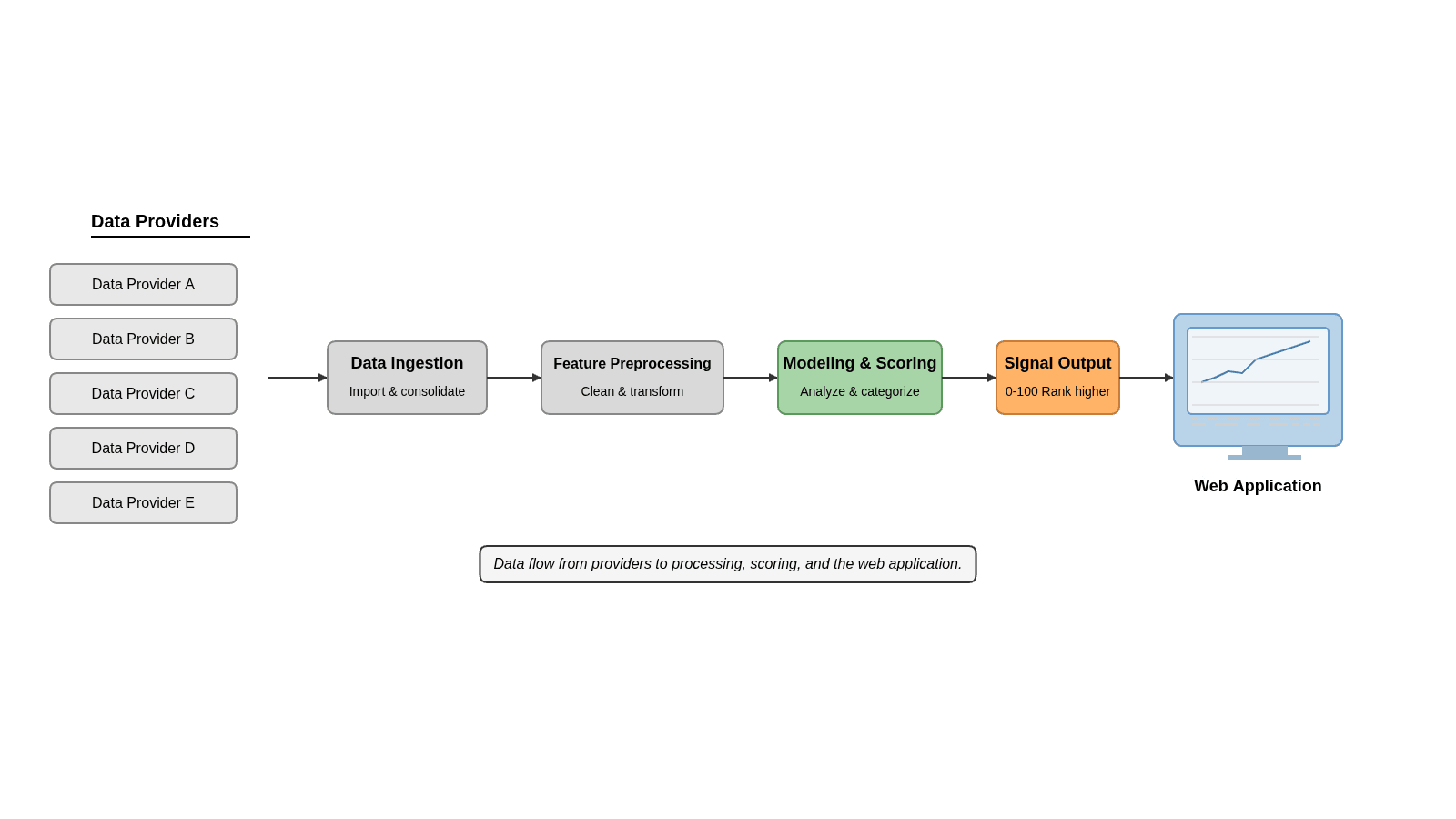
Internal components are simplified in this public view. Click the image to enlarge.
A glimpse into what the AI evaluates
Each ranking is generated by models that evaluate more than 1,000 individual signals across price behavior, fundamentals, valuation, risk, and cash-flow quality. Below is a small, non-exhaustive sample of the types of metrics that feed into the analysis.
- Short-, medium-, and long-term price momentum
- Year-to-date and multi-year price performance
- Quarterly revenue growth and operating income trends
- Realized price volatility across multiple time horizons
- Market beta and sensitivity to broader indices
- Distance from 52-week highs and lows
- Price relative to long-term moving averages and VWAP
- Balance sheet leverage and adjusted debt-to-equity ratios
- Total debt growth, issuance, and capital structure changes
- Free cash flow margins and cumulative cash flow growth
- Capital expenditure trends and investment intensity
- Gross profit levels and return on assets
- Valuation multiples relative to historical averages
- Dividend yield consistency, payout ratios, and distributions
- Analyst-derived fair value and discounted cash flow estimates
- Liquidity positioning and working capital efficiency
- Operational efficiency and cost structure evolution
- Geographic and operating region exposure
No single metric determines a ranking. Signals emerge when multiple independent dimensions align, creating a relative opportunity within the current market environment.
What to keep in mind
- Signals can be wrong.
- Markets change regimes.
- Volatile stocks move sharply.
- Consistency matters more than any single signal.
Not investment advice
Stock Outperformers provides informational signals for research and decision support. You are responsible for your own investment decisions and risk management.